Henry reveals his time-travel condition to his coworkers
The Time Traveler's WifeHenry’s disclosure to his Newberry Library coworkers turns an extraordinary private condition into a workplace fact: after finding one version of himself trapped inside the Cage, he must explain time travel to Roberto Calle, Matt, and Catherine while another version of himself stands outside it. The scene makes the condition tangible to skeptical witnesses, but it does not make it ordinary; Henry’s account links the physical impossibility they see to years of concealment, fear, and attempts to maintain a normal job and life.
The discovery in the Cage
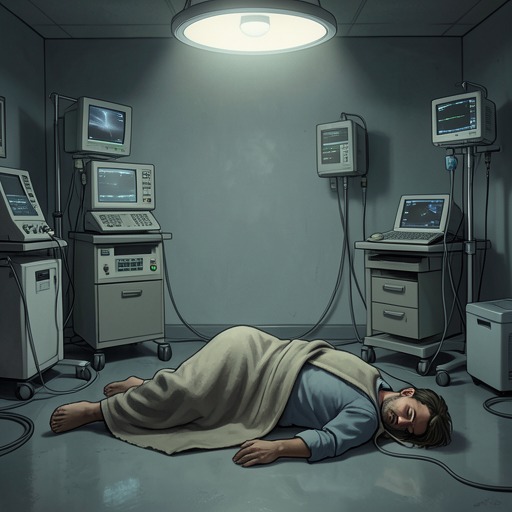
On Wednesday, June 28, 2006, Henry comes to in the dark on the concrete floor of the Newberry Library’s Cage, the steel-enclosed special-collections area. He is disoriented and has struck his head. When the lights come on, Kevin, a security guard, finds him naked and pretending to be unconscious. Kevin calls for assistance, and the guards consider whether he may be injured and need to be freed from the enclosure. Henry eventually groans and sits up, refusing the prospect of a larger rescue response.
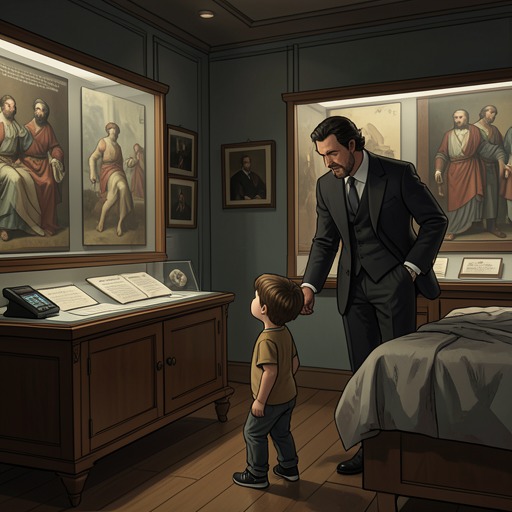
The security staff bring Henry his clothes through the mesh. Roy, another guard, also brings him coffee with a straw and a sweet roll. These practical gestures establish the scene’s peculiar mixture of routine care and bafflement: Henry is a familiar library employee, but he is trapped in a restricted area with no explanation that his colleagues can accept. When Roberto arrives, Henry is dressed and alone with the supervisor he respects, facing the truth after repeated lies.
Two Henrys and a witness
The disclosure takes shape through a second encounter. On a September morning, a Henry arrives at work after dealing with delays involving his daughter, Alba, and the train. He finds Matt in his office. Matt turns pale and asks how Henry escaped the Cage, because he has just come from downstairs, where another Henry remains trapped with Roberto. The discrepancy is no longer a claim Henry can simply make or retract: Matt has encountered both men within the same working day.
Henry goes downstairs with Catherine, while Roy stays nearby. Roberto is still at the foot of the stairs, insisting that what he has been told sounds like science fiction. The arriving Henry sees his other self inside the Cage, dressed in a white shirt and khakis, cold and hungry, with a cup of coffee outside the enclosure. He asks when the trapped Henry is from. The answer is August 2006; the trapped version estimates that he has about half an hour left before he disappears. The Henry outside the Cage passes in the coffee and sweet roll, making the temporal contradiction visible through an everyday exchange across the steel mesh.
What Henry explains
With the trapped Henry’s permission, the arriving Henry gives the account. He explains that he travels through time involuntarily, describing the condition as a kind of disease with practical and genetic dimensions rather than an ability he can control. He tells his coworkers about Kendrick’s involvement, his meeting and later reunion with Clare, and the causal loops and scientific concepts he associates with the condition, including quantum mechanics, photons, and the speed of light.
The explanation also shifts from theory to consequences. Henry describes what it is like to live outside the temporal constraints that govern most people, and connects the condition to lying, stealing, and fear. He frames the effort to have a normal life as central to the account, concluding that a normal job is part of that effort. Catherine observes that the job is not really normal, while the Henry inside the Cage adds that neither is the life. Their responses expose the distance between Henry’s goal of ordinary participation and the disruptive reality his colleagues have witnessed.
Trust and the outcome
Henry asks Roberto whether the disclosure will cost him his job. Roberto says he will not fire him, but asks why Henry did not explain the situation long ago. The question makes the interpersonal cost of secrecy explicit: Henry has not merely withheld a technical fact from an employer; he has repeatedly lied to someone whose respect matters to him. Henry’s answer is that Roberto would not have believed him, pointing out that Roberto did not believe the explanation until he saw the two versions himself.
The scene does not end with full understanding or a clean reconciliation. Roberto begins to respond, but Henry disappears amid the sound associated with his comings and goings. His clothes remain inside the Cage, and he plans to retrieve them later with a clothes hanger. Matt, Roberto, and Catherine are left stunned. Roberto’s decision preserves Henry’s employment, but the event leaves his coworkers to absorb the evidence of a condition that explanation alone could not make credible.
Narrative significance
The episode converts an isolated, baffling incident into a witnessed demonstration. The Cage, normally a barrier protecting special collections, becomes the visible boundary between two versions of the same employee and two different dates. Coffee and food pass through its mesh even as ordinary explanation fails to bridge the temporal divide. By staging the disclosure in a workplace, the narrative tests Henry’s wish for a normal job against the practical demands of a condition that repeatedly interrupts his presence.
The scene also changes the basis of the coworkers’ knowledge. Before they see the two Henrys, the account can be dismissed as science fiction; once they do, disbelief gives way to shock, though not to complete comprehension. Henry’s partial exposure brings relief from one sustained deception and creates a new, shared fact among his colleagues, while his abrupt disappearance ensures that even the act of telling cannot make him reliably present.